

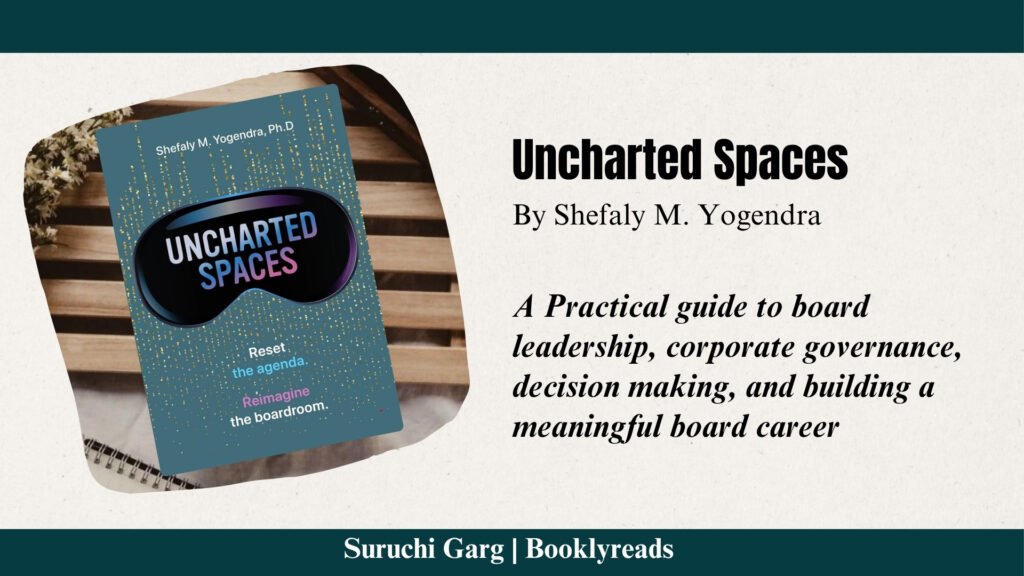
Uncharted Spaces by Shefaly M. Yogendra- Book Feature
What does it really take to become an effective board director?
It is easy to associate boardrooms with power, prestige, and important decisions. But effective board leadership requires much more than a title.
Uncharted Spaces by Shefaly Yogendra offers a thoughtful look into the realities of board leadership, governance, decision-making, relationships, risk, technology, and professional growth.
The book combines personal experiences with insights into how modern boards work. It also explores how aspiring directors can prepare for a board career and how experienced leaders can remain relevant as businesses and societies change.
But many of its lessons extend beyond the boardroom.
Whether you are building a career, leading a team, running a business, or making important decisions, the ideas around curiosity, preparation, independent thinking, relationships, and future relevance are worth applying.
Buy your copy of Uncharted Spaces by Shefaly Yogendra here
What Is Uncharted Spaces About?
Uncharted Spaces explores the changing world of board leadership and corporate governance through Shefaly Yogendra’s experiences and conversations with directors.
The book takes readers behind the formal structure of the boardroom. It looks at what directors actually do, how they prepare for new roles, how they understand organisations, and how they navigate difficult decisions.
It covers topics including the first 100 days on a board, board responsibilities, governance, risk, technology, artificial intelligence, geopolitics, boardroom dynamics, and the changing expectations of directors.
One of the most useful aspects is its practical approach.
Board leadership is not presented simply as a prestigious position. It requires preparation, judgement, curiosity, relationships, and the courage to question what others may overlook.
For anyone interested in board careers, leadership, governance, or strategic decision-making, the book provides plenty to think about.
Key Lessons From Uncharted Spaces
1. Know Your “Why” Before Your “How”
Before chasing a role, opportunity, title, or achievement, understand why you actually want it.
Your “how” can change. Your strategy can change. The path can change. But if you don’t know what you’re trying to build or why it matters to you, it becomes very easy to follow someone else’s definition of success.
A clear “why” also helps you recognise opportunities that genuinely fit and reject impressive-looking ones that don’t. Before making your next big career decision, ask yourself:
What am I actually trying to create, contribute, or change?
The clearer the answer, the easier it becomes to decide what deserves your time.
2. Curiosity and Patience Are a Powerful Combination
Curiosity makes you ask better questions. Patience gives you the willingness to stay with those questions long enough to understand what is really happening.
Not every problem needs an immediate answer.
Sometimes you need to understand the moving parts, the context, the people involved, and the forces influencing the situation before deciding what to do.
This applies far beyond business.
When something goes wrong, resist the urge to immediately react. Get curious first.
What am I missing?
What caused this?
What else could be influencing it?
What happens if I look at this from another perspective?
Good judgement often comes from understanding something deeply rather than responding quickly.
3. Don’t Just Look for Opportunities, Build Relationships Before You Need Them
The strongest professional relationships are rarely built when you urgently need something.
They are built much earlier, through genuine conversations, generosity, shared interests, useful contributions, and consistent connection.
Instead of thinking, “Who can help me get my next opportunity?”, think:
“What value can I create for the people and communities I’m part of?”
You don’t need to collect hundreds of contacts.
Build a smaller network of people who know how you think, what you care about, and what you are good at. And importantly, nurture those relationships even when you aren’t asking for anything. Opportunities often travel through trust.
4. Your Biggest Advantage May Be the Combination of Skills You Already Have
You don’t always need another qualification to become more valuable.
Sometimes the real opportunity is to recognise the unusual combination of skills, experiences, interests, and perspectives you already possess.
One person might understand technology and psychology. Another might combine finance with storytelling.
Someone else might bring together engineering, strategy, geopolitics, and an understanding of people. Individually, these skills may not seem extraordinary.
Their combination can be.
Instead of asking only, “What skills do I need to acquire?”, ask:
“What do I know that becomes unusually valuable when combined?”
That combination can become your professional positioning.
5. What Everyone Can See Isn’t Always What You Need to Question
It is easy to challenge what is directly in front of you.
The harder and often more valuable question is:
What is missing?
In meetings, reports, plans, conversations, and even your own thinking, pay attention to what isn’t being discussed.
- What assumption is everyone accepting?
- Which perspective isn’t represented?
- What information would change the decision if you had it?
- What question would make everyone uncomfortable?
This habit can dramatically improve your decision-making.
Don’t just become someone who can analyse the information presented to you. Become someone who can recognise the information that should have been presented but wasn’t.
6. The First 100 Days Are for Understanding, Not Proving Yourself
When you enter a new job, team, business, or environment, you don’t need to immediately demonstrate that you have all the answers.
Use your beginner’s perspective.
Observe.
Listen.
Ask questions.
Learn how decisions actually get made.
Understand the people, culture, incentives, relationships, and unwritten rules.
The advantage of being new is that you notice things existing members have become accustomed to. Instead of rushing to fit in, use that period to build a mental map of the environment. And remember:
The more obvious something seems, the more interesting it can be to ask why it is that way.
7. Do Your Own Due Diligence, Especially When Something Looks Impressive
An impressive opportunity can still be the wrong opportunity.
A prestigious title, successful company, attractive salary, influential people, or exciting project should never replace your own investigation.
Before saying yes, ask:
What am I not being told?
What could go wrong?
What are the expectations?
Who makes the decisions?
What are the risks?
What would this cost me beyond money?
Don’t allow urgency, prestige, or someone else’s confidence to replace your judgement. The goal isn’t to become suspicious of everything. It is to become responsible for forming your own view before making an important commitment.
8. Future Relevance Requires Continuous Reinvention
Your previous success does not automatically make you valuable in the future.
Industries change. Technology changes. Regulations change. Customer expectations change. Entire business models can change.
So the question isn’t just:
“What am I good at today?”
It is:
“What will continue to matter tomorrow?”
Stay curious about technology, society, markets, people, and the forces reshaping your field.
Keep learning beyond your immediate job description. And periodically reassess your own relevance. A career shouldn’t only be built around what you have already mastered. It should also leave room for what you still need to become.
9. Independence Doesn’t Mean Working Alone
Being independent doesn’t mean refusing help, avoiding collaboration, or trying to figure everything out yourself. It means being capable of listening to everyone around you without surrendering your own judgement.
You can take advice from experts, learn from experienced people, understand different perspectives, and still form your own conclusion. This becomes especially important when everyone around you seems to agree. Before going along with the majority, pause and ask:
“Do I genuinely agree, or have I simply become comfortable agreeing?”
Healthy independence is not about being difficult or contrarian. It is about being willing to say, “I see it differently,” when your judgement tells you that you should.
10. Your Reputation Is Built Long Before You Need It
Your professional reputation isn’t created when you finally need an opportunity. It is built quietly through hundreds of smaller choices like how you behave when nobody is watching, whether you keep your word, how you treat people, the quality of your work, the questions you ask, and the value you consistently bring.
That means reputation shouldn’t be treated as a personal-branding exercise alone. It is an accumulation of evidence. People should be able to associate your name with certain qualities because they’ve experienced them repeatedly.
So instead of asking:
“How do I make people notice me?”
Ask:
“What do I want people to consistently trust me for?”
Then build that reputation one interaction, one piece of work, and one relationship at a time.
Buy your copy of Uncharted Spaces by Shefaly Yogendra here
What Makes Uncharted Spaces Different?
Many books about leadership focus on theories, frameworks, or success formulas. Uncharted Spaces takes a different route.
It combines personal experience, boardroom realities, governance insights, and conversations with directors to show what leadership looks like behind the title.
It also avoids presenting board directorship as a simple destination. Instead, it explores the preparation, judgement, relationships, responsibilities, risks, and continuous learning involved in becoming an effective director.
Another strength is its relevance beyond corporate boardrooms. Ideas about curiosity, due diligence, independent judgement, networking, preparation, and future relevance can be applied to almost any professional environment.
That makes the book useful not only for current directors but also for people thinking about their next stage of leadership.
Who Should Read Bring Your Own Shark?
This book is especially valuable for:
- Aspiring board directors looking to understand board careers and governance.
- Senior executives, founders, and business leaders who want to strengthen strategic thinking, improve their judgement and decision-making.
- Current directors and Chairs interested in modern boardroom challenges.
- Young professionals and future leaders who want to learn about corporate governance, responsible decision-making, and effective leadership early in their careers.
- Students and future professionals curious about how organisations are governed and important decisions are made.
- Readers interested in corporate governance and boardroom dynamics
- Anyone curious about how modern organisations make important decisions
You do not need to be pursuing a board position to take something valuable from this book. Learning to question, evaluate, decide, and lead responsibly can prepare you for the leadership roles of tomorrow.
If you are interested in leadership, governance, professional growth, strategy, and better decision-making, many of its lessons can be applied to your own career.
Final Thoughts:
Uncharted Spaces is ultimately about more than getting a seat in the boardroom.
It is about learning how to think independently, ask better questions, understand complexity, build meaningful relationships, and remain relevant as the world changes.
One of the biggest takeaways is that leadership is not simply about having answers.
It is also about knowing what to question, what to investigate, what to notice, and when to speak up.
That makes the book especially relevant in a world where businesses face increasingly complex challenges involving technology, geopolitics, regulation, risk, and changing expectations.
For anyone interested in board leadership, corporate governance, business leadership, or professional growth, Uncharted Spaces offers plenty of practical ideas to reflect on and apply.
Frequently Asked Questions (FAQ)
What is Uncharted Spaces by Shefaly Yogendra about?
Uncharted Spaces explores board leadership, corporate governance, decision-making, and the changing role of board directors. It combines personal experiences with practical insights into how modern boards work.
What can you learn from Uncharted Spaces?
Readers can learn about effective decision-making, corporate governance, boardroom dynamics, due diligence, independent judgement, professional relationships, leadership, and staying relevant in a changing business environment.
Is Uncharted Spaces useful for young professionals?
Yes. Young professionals can learn about corporate governance, responsible decision-making, strategic thinking, and leadership early in their careers, helping them prepare for future leadership and boardroom responsibilities.
Is Uncharted Spaces only for people who want to become board directors?
No. Although board leadership is central to the book, many of its lessons apply to anyone interested in leadership, decision-making, professional growth, strategy, and organisational management.
What makes Uncharted Spaces different from other leadership books?
It offers a practical look at what happens behind the boardroom door. Rather than focusing only on leadership theory, it explores real boardroom responsibilities, governance, relationships, risks, and the changing challenges faced by directors.
You might also like
- All Posts
- Book Recommendations
- Non-Fiction Books
- Author Interviews
Recent Posts

Suruchi Garg
Suruchi is a reader and book influencer passionate about helping readers find books that truly impact their lives. She was listed as Top book influencer among top 60 Indian book influencers in 2025. With the experience of over 4 years and was trusted by more than 300 authors she aims to make reading a transformative experience.
Latest Blog


Featured
Sign Up for The Newsletter for Updates on Writing, Tour, and More

Book influencer and self help enthusiast.
Book influencer and self help enthusiast.
Contact Info
readsbookly@gmail.com
@booklyreads
Navigation
- Home
- About
- Book
- Contact