

The Rigged Game by Amit Marwah and Abhishek Marwah
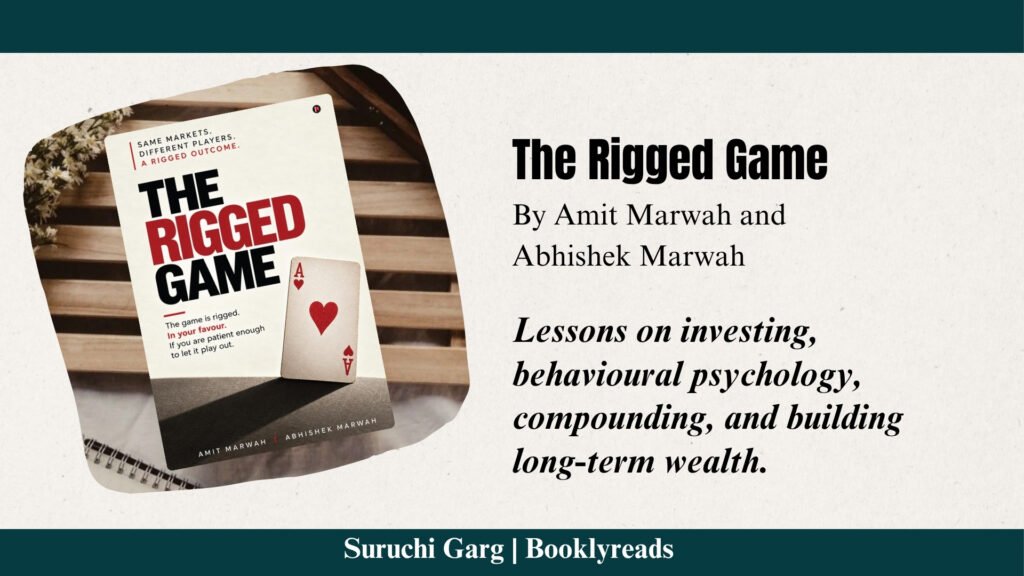
The Rigged Game by Amit Marwah and Abhishek Marwah: A Guide to Building Long-Term Wealth
Building wealth is not always about finding the perfect investment, predicting market movements, or making brilliant financial decisions. Sometimes, it is about understanding how money works, managing your emotions, and having the patience to let your investments grow over time.
The Rigged Game by Amit Marwah and Abhishek Marwah explores this idea through the principles of investing, behavioural psychology, asset allocation, and wealth creation. The book challenges common assumptions about financial markets and explains why ordinary investors can build substantial wealth by following a disciplined, long-term approach.
Rather than focusing solely on stock selection or market predictions, the authors examine the psychological mistakes that prevent investors from achieving their financial goals. From understanding market volatility to recognising the power of compounding, the book offers a framework for making more thoughtful investment decisions.
The central idea is simple: the investing game can work in your favour when you understand its rules and learn to stay invested through uncertainty.
Buy your copy of The Rigged Game here
What Is The Rigged Game About?
The Rigged Game is a book about investing, financial behaviour, and the principles that help people build wealth over the long term. It explains why successful investing often depends less on predicting the future and more on developing a sound process that can withstand changing market conditions.
The book explores several interconnected themes, including asset allocation, systematic investing through SIPs, value investing, mean reversion, diversification, risk management, and the emotional challenges of investing.
One of its central arguments is that investors frequently undermine their own returns by reacting emotionally to market movements. They buy when optimism is high, sell when fear takes over, and abandon strategies before those strategies have time to work.
The authors also explore less-discussed aspects of wealth creation, such as currency diversification, real estate, financial advisers, Stoic philosophy, and preparing the next generation to preserve wealth.
What makes the book particularly relevant is its emphasis on the investor’s behaviour. It encourages readers to build a repeatable investment process, understand their own risk tolerance, and make decisions based on evidence rather than temporary market sentiment.
Ultimately, The Rigged Game presents wealth creation as a long-term process built on discipline, patience, and consistent decision-making.
Key Lessons From The Rigged Game
1. Your Biggest Investment Advantage Is Behaviour
Investors often spend considerable time searching for the best stocks, funds, or market opportunities. However, even a good investment strategy can fail when fear, greed, and impatience influence decisions.
The book explains how panic selling, chasing recent performance, and constantly changing strategies can damage long-term returns. Learning to recognise these behavioural patterns can be just as important as understanding financial analysis.
2. Start Early and Let Compounding Work
Compounding allows your returns to generate further returns over time. Its impact may appear small during the early years, but the effect can become substantial as your investment base grows.
One important lesson from the book is that starting early can be more valuable than waiting until you have a sophisticated strategy or a large amount of money to invest.
Time is an asset that cannot be recovered once it has been lost.
3. Consistency Matters More Than Perfect Timing
Many investors wait for the ideal moment to enter the market. Others attempt to sell before a decline and buy again when conditions appear safer.
The problem is that market bottoms and recoveries are difficult to identify in real time. Waiting for certainty can mean missing important periods of growth.
The book encourages systematic investing and consistency rather than relying on perfect predictions. A sound strategy followed over time can be more effective than a supposedly perfect strategy abandoned under pressure.
4. Understand the Difference Between Price and Value
A falling stock price does not automatically make an investment attractive, just as a rising price does not necessarily mean an investment is overvalued.
Value investing requires examining the underlying business, its financial fundamentals, and the difference between its estimated worth and its market price.
The book highlights the importance of understanding what you are buying rather than simply following market trends or popular narratives.
5. Diversification Is About More Than Owning Many Investments
Owning several investments does not necessarily mean your portfolio is well diversified. If those investments respond to the same economic conditions, they may decline together.
The book discusses diversification across asset classes, geographies, and currencies. The objective is to build a portfolio in which different components serve different purposes and do not all depend on the same market conditions.
6. Focus on What You Can Control
Market movements, geopolitical developments, and economic events are largely outside an individual investor’s control. Savings habits, portfolio allocation, investment discipline, and responses to volatility are not.
Drawing on Stoic philosophy, the book encourages investors to direct their attention towards their own decisions rather than becoming consumed by unpredictable external events.
This shift can reduce unnecessary anxiety and help investors make more rational choices during uncertain periods.
7. Know When to Hold and When to Exit
Patience does not mean holding every investment indefinitely. The book distinguishes between temporary price movements and meaningful changes in an investment’s underlying thesis.
An investor should reassess whether the original reasons for buying still hold true. If the fundamentals have changed, continuing to hold simply because of an attachment to the investment may become a mistake.
The lesson is to make exit decisions based on evidence, valuation, and the investment thesis rather than fear, excitement, or the size of a profit or loss.
8. Build Wealth That Can Survive Beyond You
Wealth creation is only one part of financial planning. Preserving that wealth across generations requires financial literacy, practical experience, organised documentation, and open conversations about money.
The book emphasises that passing on assets without passing on the principles behind them can leave the next generation unprepared to manage what they inherit.
Teaching the next generation how wealth is built and maintained may be just as important as building the wealth itself.
Buy your copy of The Rigged Game here
What Makes The Rigged Game Different?
One of the distinctive features of The Rigged Game is its emphasis on the psychology behind investing. Instead of treating financial success as a matter of intelligence or superior predictions alone, it examines why people make poor decisions even when they understand the principles of investing.
The book connects practical financial concepts with human behaviour. Topics such as mean reversion, asset allocation, and compounding are explored alongside fear, overconfidence, regret, social pressure, and the difficulty of remaining patient.
It also looks beyond conventional stock-market advice. Discussions of Stoicism, financial advisers, reading during market crashes, currency diversification, real estate, and intergenerational wealth make the scope broader than a typical introduction to investing.
Another distinguishing aspect is its focus on process over perfection. The book does not suggest that investors need to predict every market movement correctly. Instead, it emphasises building a strategy that can be followed consistently despite uncertainty.
Its central message is that understanding the principles is only the beginning. The real challenge is applying them when markets are falling, uncertainty is high, and emotional reactions make rational decisions difficult.
Who Should Read The Rigged Game?
The Rigged Game may be particularly useful for:
Beginner investors: Readers who want to understand the foundations of long-term investing, systematic investing, diversification, and compounding.
Salaried professionals: People who want to build wealth gradually through regular savings and disciplined investment habits.
Investors who struggle with market volatility: Those who feel anxious during corrections or frequently question their investment decisions.
Long-term wealth builders: Readers interested in asset allocation, value investing, portfolio construction, and maintaining investment discipline.
People interested in behavioural psychology: Anyone curious about how emotions, cognitive biases, and social pressure influence financial decisions.
Families planning for generational wealth: Readers who want to understand the importance of financial education, wealth preservation, and preparing heirs to manage assets responsibly.
The book is best approached as an educational resource for developing a long-term investment mindset. Its concepts can help readers ask better questions about their financial decisions, although individual investments and allocations still need to reflect personal circumstances, goals, and risk tolerance.
Final Thoughts
The Rigged Game by Amit Marwah and Abhishek Marwah presents a compelling perspective on why building wealth is often less about being exceptionally clever and more about developing the discipline to follow sound principles over time.
Its strongest theme is the relationship between financial knowledge and human behaviour. Knowing that markets fluctuate is different from remaining calm when your portfolio declines. Understanding compounding is different from resisting the temptation to withdraw money unnecessarily. Recognising the value of a long-term strategy is different from continuing to follow it when it temporarily underperforms.
The book brings these challenges together and encourages readers to think beyond individual investment decisions towards the habits, systems, and mental frameworks that support long-term wealth creation.
For readers who want to understand not only how investing works but also why investors often work against their own interests, The Rigged Game offers several useful ideas to explore.
The ultimate lesson is straightforward: you do not need to predict every market movement or make perfect decisions. You need a sound process, a clear understanding of risk, and the patience to stay committed to your long-term goals.
Build your knowledge, trust a well-researched process, and give time the opportunity to work in your favour.
Frequently Asked Questions (FAQ)
What is The Rigged Game by Amit Marwah and Abhishek Marwah about?
The Rigged Game is a book about investing, wealth creation, and behavioural psychology. It explores concepts such as compounding, asset allocation, diversification, mean reversion, and systematic investing while explaining how emotions and behavioural biases influence financial decisions.
What are the key lessons from The Rigged Game?
Some of the key lessons include starting early to benefit from compounding, investing consistently, understanding the difference between price and value, diversifying your portfolio, managing emotions during market volatility, and maintaining a long-term investment strategy.
Is The Rigged Game suitable for beginners?
Yes, the book can be useful for beginners interested in understanding the principles of long-term investing and wealth creation. It introduces important financial concepts and highlights the habits and psychological discipline required to make more thoughtful investment decisions.
What does The Rigged Game teach about investor psychology?
The book explains how fear, greed, overconfidence, regret, and herd behaviour can lead to poor investment decisions. It encourages investors to recognise these emotional patterns and follow a well-considered process instead of reacting impulsively to market movements.
What makes The Rigged Game different from other investing books?
The book combines investment principles with behavioural psychology and practical approaches to managing uncertainty. Alongside topics such as compounding and diversification, it explores Stoicism, financial advice, reading during market crashes, and passing financial knowledge on to the next generation.
You might also like
- All Posts
- Book Recommendations
- Non-Fiction Books
- Author Interviews
Recent Posts

Suruchi Garg
Suruchi is a reader and book influencer passionate about helping readers find books that truly impact their lives. She was listed as Top book influencer among top 60 Indian book influencers in 2025. With the experience of over 4 years and was trusted by more than 300 authors she aims to make reading a transformative experience.
Latest Blog

Featured


Sign Up for The Newsletter for Updates on Writing, Tour, and More

Book influencer and self help enthusiast.
Book influencer and self help enthusiast.
Contact Info
readsbookly@gmail.com
@booklyreads
Navigation
- Home
- About
- Book
- Contact