

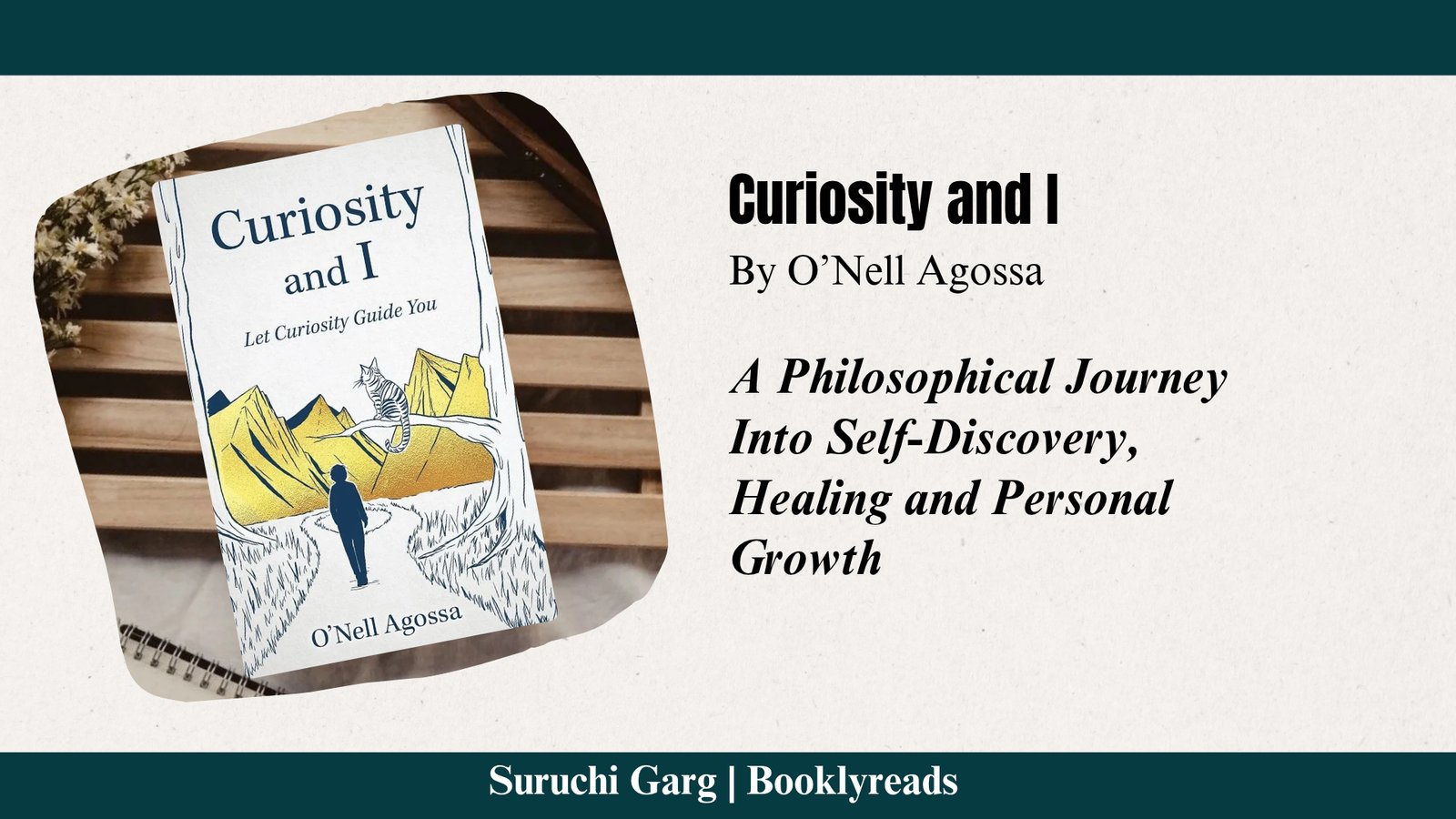
Curiosity and I by O’Nell Agossa | Book Feature

Curiosity and I by O’Nell Agossa: A Philosophical Journey Into Self-Discovery, Healing and Personal Growth
What if curiosity could help you understand yourself, heal from the past, build better relationships and become a better version of yourself?
Curiosity and I by O’Nell Agossa is a philosophical fiction book that takes readers on a journey of self-discovery, emotional healing and personal transformation.
Through a fictional journey with Curiosity, the narrator explores grief, fear, pain, identity, love, relationships, people-pleasing, ego and comparison.
The central idea is simple: curiosity isn’t just about asking questions or discovering something new. It’s also about understanding your emotions, questioning your beliefs, accepting change and becoming more aware of how you experience life.
If you enjoy philosophical fiction, introspective storytelling and books that make you reflect on your own life, this is a meaningful read to consider.
Buy your copy of Curiosity and I here
What Is Curiosity and I About?
The story follows a narrator who enters an extraordinary inner world and meets Curiosity, a mysterious guide who takes different animal forms.
Together, they embark on a three-day journey through symbolic landscapes and meaningful encounters. Interestingly, only an hour passes in the real world.
Their journey unfolds through three parts:
Part I: Echoes of Curiosity
The first part explores childhood, memories, early experiences and the discovery of inward and outward curiosity. It introduces how our surroundings shape our understanding of ourselves and the world.
Part II: Inward Curiosity
This part focuses on understanding grief, fear, pain, identity and self-acceptance. The narrator learns to confront difficult emotions rather than allowing them to define their entire existence.
Part III: Outward Curiosity
The final part explores relationships, empathy, love, boundaries, people-pleasing, ego and comparison. It also introduces three principles for practising curiosity: honesty, action and consistency.
As the journey progresses, curiosity becomes a way to understand ourselves, connect with others and approach life’s uncertainties with greater awareness.
12 Important Life Lessons From Curiosity and I
1. Everyone is experiencing life for the first time
One of the most beautiful ideas in the book is that everyone we encounter is navigating life without having experienced it before.
We often assume that age, experience or someone’s outward confidence means they have everything figured out. But every person is dealing with their own uncertainties, fears, relationships, expectations and unanswered questions.
The author reminds us to look beyond people’s roles and appearances.
Our parents are not just parents. Our friends are not just friends. Every person has a story, an identity and an inner world that we may never completely understand.
Approach people with more empathy. Instead of assuming you know what someone is going through, remain curious about their experiences.
2. The most important experiences are meant to be lived, not solved
We live in a world that encourages us to analyse everything, find explanations and constantly look for solutions.
Sometimes, however, we turn life into a problem that needs to be solved.
We overthink our feelings, question every decision and try to understand every experience before allowing ourselves to live through it.
The book challenges this tendency.
Not every emotion needs an immediate explanation. Not every experience has a clear answer. Some moments simply need to be experienced.
Give yourself permission to live without analysing every detail. Reflection is valuable, but don’t let overthinking take you away from the experience itself.
3. Grief is a testament to what mattered to us
The book explores grief as more than sadness over losing someone or something.
We can grieve people, relationships, childhood innocence, old identities, opportunities we missed and versions of ourselves that no longer exist.
One particularly meaningful idea is that grief should be honoured rather than avoided.
We cannot always control when grief appears, and healing does not follow a perfectly organised timeline.
You don’t have to rush yourself through grief. Allow yourself to feel what you feel, learn from the experience and gradually move forward without denying what mattered to you.
4. You are not your pain
One of the strongest lessons comes from the narrator’s encounter with pain.
The book explores how, when we stop trying to understand our emotions, they can become so closely connected to our identity that we begin defining ourselves through them.
There is a difference between saying that we are in pain and recognising that we are experiencing pain.
The distinction may seem small, but it changes how we relate to difficult emotions.
Your experiences are part of your story, but they do not have to become your entire identity. You can acknowledge pain without believing that it defines who you are.
5. Fearlessness is not the absence of fear
We often imagine confident people as those who never feel afraid.
But the book presents a different understanding of courage.
Fear can exist even when we are making the right decision. We may fear failure, rejection, vulnerability, uncertainty or the possibility of getting hurt.
The goal is not necessarily to eliminate fear. It is to develop the courage to act even when fear is present.
Don’t wait until you feel completely fearless to take a step forward. Sometimes courage begins with acknowledging your fear and moving anyway.
6. Your identity is not fixed
We often attach ourselves to particular identities.
We may define ourselves through our profession, achievements, relationships, childhood experiences, personality traits or the expectations of others.
But life keeps changing, and so do we.
The person you were five years ago does not have to be the person you remain today.
The book encourages us to question the labels and beliefs we have attached to ourselves.
Give yourself permission to change. You are allowed to outgrow old identities, question your beliefs and become someone you have not yet imagined.
7. Relationships need curiosity, not control
One of the most interesting ideas in the book is that every relationship is a meeting of two different universes.
Every person has their own memories, fears, expectations, experiences and ways of understanding the world.
When two people come together, they bring these different worlds into a shared relationship.
Love alone does not automatically make a relationship healthy. It also requires friendship, communication, empathy, patience and a willingness to understand each other.
The author makes an important distinction between wanting to understand someone and wanting to control or change them.
Instead of assuming you already know everything about someone you love, remain curious about who they are becoming. Listen to understand, not simply to respond.
8. People-pleasing can disguise itself as love
The book identifies people-pleasing as one of the three impostors of curiosity.
It can make us believe that constantly saying yes, avoiding disagreements and ignoring our own needs are signs of love and kindness.
But there is a difference between genuinely caring for someone and abandoning ourselves to keep them happy.
When we repeatedly ignore our boundaries, resentment can quietly build.
Being considerate does not mean being available for everything. You can love people, support them and still say no when something does not feel right.
9. Ego can trap us in an image of ourselves
Ego is another impostor explored in the book.
It can make us overly attached to how we see ourselves and how we want others to see us.
Sometimes, even our desire to become better can be influenced by the need to protect a particular image.
Genuine self-awareness requires us to look at ourselves honestly, including the parts we don’t particularly like.
Don’t become so attached to the person you believe you are that you stop allowing yourself to grow.
10. Comparison makes us forget our own journey
Comparison is described as a thief that takes away our inner peace.
We compare our achievements, appearance, relationships, careers and lifestyles with people whose circumstances and experiences we may know very little about.
The problem is that comparison keeps changing the standard. Even when we achieve something, there is always someone else who appears to be doing better.
We end up chasing a moving target.
Take inspiration from others, but don’t use their lives as a measurement of your own progress. Focus on who you are becoming.
11. Curiosity needs action and consistency
This is one of the most practical lessons in the final chapters.
The book explains that recognising an opportunity or feeling interested in something is only the beginning.
Curiosity needs to be activated through intentional action.
You don’t always need to make a dramatic change. Sometimes the smallest step is enough to begin.
And when you repeat these small actions consistently, they gradually build momentum.
Don’t just think about what interests you. Take one small action towards exploring it. Keep learning, experimenting and adjusting along the way.
12. Your circumstances don’t determine how you respond to life
The final chapter explores luck, privilege and the unequal realities people are born into.
Through the encounter between two children living very different lives, the narrator questions how much of our success and circumstances are actually within our control.
We often celebrate people as entirely self-made without acknowledging the opportunities, support systems and circumstances that helped shape their journeys.
The book doesn’t suggest that personal agency is meaningless. Instead, it encourages us to recognise both the influence of external circumstances and the power we have over our responses.
It also reminds us that privilege should inspire gratitude and responsibility rather than guilt or superiority.
Acknowledge the opportunities you have received, respect the realities of others and use whatever agency you have to make a positive contribution.
Buy your copy of Curiosity and I here
Three Principles for Practising Curiosity
Towards the end of the book, three guiding principles bring the entire philosophy together.
1. Curiosity is honest
Be honest about what you genuinely want. Don’t pursue something just for validation, comparison or external approval. Respect your boundaries and accept that not every opportunity is meant for you.
2. Curiosity is active
Awareness must lead to action. If something interests you, explore it. Ask questions, start conversations, learn new things and take small steps towards what matters.
3. Curiosity compounds
Small actions repeated consistently create meaningful change. Keep learning, experimenting and improving. You don’t need dramatic transformations; you need the willingness to keep going.
What Makes Curiosity and I Different?
There are plenty of books about self-awareness, emotional intelligence, personal growth and mindfulness. What makes this book interesting is the way it brings these ideas together through a fictional journey.
Rather than presenting a conventional list of self-help instructions, the author uses conversations, memories, symbolic landscapes and encounters to explore the human experience.
Curiosity itself is also an interesting character. It is not presented as someone who simply provides answers. Instead, it repeatedly encourages the narrator to observe, question, experience and make their own choices.
The book also makes an important distinction between inward and outward curiosity.
We can spend years trying to understand other people while knowing very little about ourselves. Equally, we can become so focused on our own experiences that we fail to understand the people around us.
The book suggests that a meaningful life requires both. It is this combination of philosophical reflection, storytelling and practical lessons that makes Curiosity and I an interesting read.
Who Should Read Curiosity and I?
This book is worth considering if you:
Enjoy philosophical fiction and meaningful storytelling.
Want to understand your emotions and behaviour better.
Are interested in self-discovery and personal growth.
Struggle with overthinking, comparison or people-pleasing.
Want to build healthier relationships.
Enjoy books that encourage reflection rather than offering quick solutions.
Reading tip: Take your time with this one. Some conversations are philosophical and idea-heavy. Pause occasionally, reflect on the questions and connect them with your own experiences.
My Final Thoughts
What I appreciate most about Curiosity and I is its reminder that personal growth begins with the willingness to remain curious.
We need to question our beliefs, understand our emotions, accept that people change and become more intentional about the way we live.
I particularly liked the progression from inward curiosity to outward curiosity. Understanding ourselves helps us approach others with greater empathy, while understanding others reminds us that everyone carries a world of experiences we cannot immediately see.
The biggest takeaway is that you don’t have to have everything figured out. You simply need to remain willing to learn, explore, change and grow.
Curiosity and I is a thoughtful read for anyone who wants to understand themselves and the world around them a little better.
Frequently Asked Questions (FAQ)
What is Curiosity and I by O’Nell Agossa about?
Curiosity and I is a philosophical fiction book about self-discovery, emotional healing, identity, relationships and personal transformation. It follows a narrator on a symbolic journey with Curiosity, exploring both the inner world of emotions and the outer world of human relationships.
What are the main lessons from Curiosity and I?
Some of the central lessons include accepting grief, understanding rather than identifying with pain, acting despite fear, allowing yourself to change, setting healthy boundaries, avoiding comparison, practising empathy and taking small consistent actions towards personal growth.
What are the three principles of curiosity?
The three guiding principles introduced in the book are:
- Curiosity is honest.
- Curiosity is active.
- Curiosity compounds.
Together, they encourage honest self-awareness, intentional action and consistent practice.
Who would enjoy reading Curiosity and I?
Readers interested in philosophical fiction, introspection, emotional healing, self-awareness, relationships and personal development may enjoy this book.
You might also like
- All Posts
- Book Recommendations
- Non-Fiction Books
- Author Interviews
Recent Posts

Suruchi Garg
Suruchi is a reader and book influencer passionate about helping readers find books that truly impact their lives. She was listed as Top book influencer among top 60 Indian book influencers in 2025. With the experience of over 4 years and was trusted by more than 300 authors she aims to make reading a transformative experience.
Latest Blog

Featured

Sign Up for The Newsletter for Updates on Writing, Tour, and More

Book influencer and self help enthusiast.
Book influencer and self help enthusiast.
Contact Info
readsbookly@gmail.com
@booklyreads
Navigation
- Home
- About
- Book
- Contact