

Thick Skin or Sharp Teeth by Shamail Aijaz
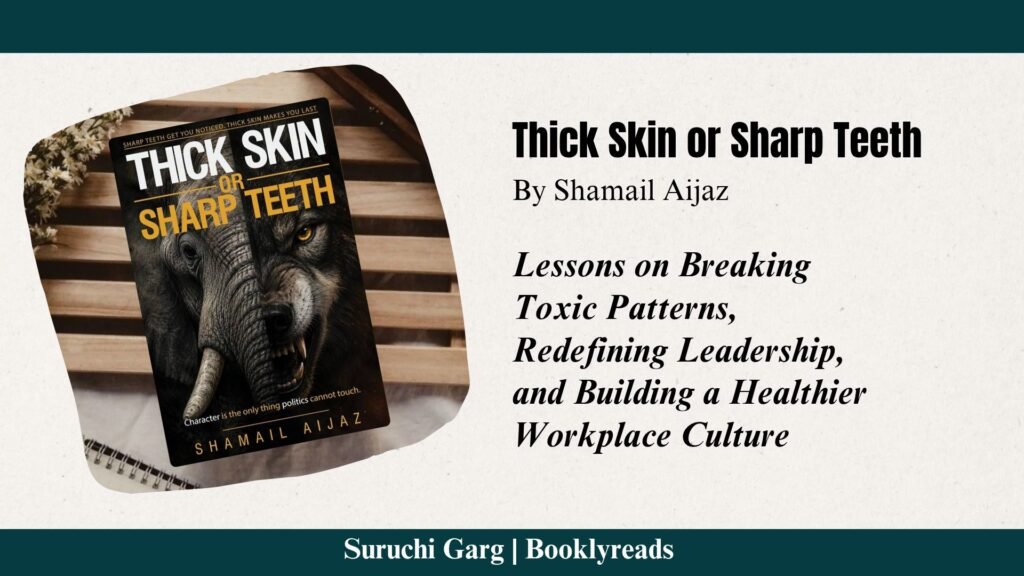
Thick Skin or Sharp Teeth: How to Navigate Office Politics Without Losing Your Character
Have you ever worked in an environment where doing good work wasn’t enough? Where being competent, honest, and hardworking didn’t necessarily mean being recognised? Where you had to think twice before speaking honestly, sharing an idea, or trusting a colleague?
Workplace politics can make even the most capable professionals question themselves. Sometimes, the pressure to survive a difficult professional environment gradually changes the way we communicate, collaborate, and see other people.
This is the central question explored in Thick Skin or Sharp Teeth: When your workplace rewards political manoeuvring, manipulation, and self-promotion, should you adapt by becoming more aggressive, or should you develop the resilience to protect your character?
The book offers a thoughtful perspective on office politics, toxic workplace behaviour, professional resilience, and ethical leadership. More importantly, it explores how to remain effective without losing the qualities that make you a good professional in the first place.
Buy your copy of Thick Skin or Sharp Teeth here
What Is Thick Skin or Sharp Teeth About?
Thick Skin or Sharp Teeth explores the challenges of navigating modern workplace culture without compromising professional integrity.
It examines why some professionals resort to credit-taking, information-hoarding, manipulation, intimidation, and political manoeuvring to advance their careers. It also explains how these behaviours influence workplace relationships, team performance, employee confidence, and organisational culture.
Rather than simply telling readers to ignore difficult colleagues or become tougher, the book introduces a more practical approach: develop thick skin.
Here, thick skin doesn’t mean becoming emotionally unavailable, tolerating disrespect, or pretending that workplace difficulties don’t affect you. It means learning to recognise situations accurately, establish healthy boundaries, maintain emotional stability, act consistently with your values, and continue contributing meaningfully.
The book also shifts its focus from individuals to organisations, explaining how leaders can create environments where honesty, collaboration, and genuine contribution are rewarded rather than political behaviour.
Ultimately, it asks professionals to consider a bigger question: What kind of person are you becoming while building your career?
The Central Idea: Thick Skin vs. Sharp Teeth
The book presents two different ways of navigating professional life.
Sharp teeth represent the behaviours people develop when they believe professional success depends on competition, manipulation, strategic relationships, taking credit, and protecting their own position at the expense of others.
Thick skin, on the other hand, represents internal resilience. It allows professionals to recognise difficult behaviour without becoming consumed by it, protect their boundaries without becoming hostile, and maintain their integrity even when the surrounding environment rewards the opposite.
The distinction is important: developing thick skin doesn’t mean allowing others to take advantage of you. It means understanding workplace dynamics without allowing those dynamics to determine your character.
The book argues that professional effectiveness and ethical behaviour are not opposing goals. You can be ambitious without being manipulative, confident without being arrogant, and resilient without becoming indifferent.
Understanding the Ten Workplace Personalities
One of the most interesting parts of the book is its exploration of ten workplace archetypes. These represent recurring patterns of behaviour that can damage professional relationships and organisational effectiveness.
1. The Talent Hunter
Targets capable professionals whose growth or visibility threatens their own position. They may quietly undermine another person’s reputation, confidence, or opportunities.
2. The Shadow Saboteur
Creates obstacles through omissions, incomplete information, unexplained delays, and subtle interference rather than obvious confrontation.
3. The Gatekeeper
Controls access to information, resources, and important relationships, distributing them selectively to maintain influence.
4. The Chameleon
Changes their positions, loyalties, and personality depending on the audience, making genuine trust difficult to establish.
5. The Credit Collector
Takes more recognition than their actual contribution deserves, often presenting collective achievements as individual accomplishments.
6. The Complaint Merchant
Consistently focuses on grievances and negativity without genuinely contributing to solutions.
7. The Political Operator
Prioritises strategic positioning, influential relationships, and organisational power over genuine professional contribution.
8. The Fear Manager
Uses intimidation and evaluative pressure to create compliance rather than genuine engagement, creativity, and confidence.
9. The Invisible Fence
Appears helpful while quietly preventing others from gaining the knowledge, access, or independence they need to progress.
10. The Morale Miner
Gradually drains collective enthusiasm through persistent negativity, discouragement, and low-grade emotional depletion.
Recognising these patterns can help professionals respond more thoughtfully. Instead of reacting emotionally to every difficult interaction, readers learn to observe behaviour, identify patterns, document important contributions, and establish appropriate boundaries.
The T.H.I.C.K. Framework: Five Principles for Professional Resilience
At the heart of the book is the T.H.I.C.K. framework, a practical approach to developing resilience while maintaining professional integrity.
T – Truth Recognition
Truth Recognition is the ability to distinguish between what is actually happening and what your emotional reaction is telling you is happening.
The book identifies four common thinking distortions: catastrophising, minimising, personalising, and generalising.
For example, one disappointing performance review doesn’t automatically mean you’re incompetent. Similarly, repeatedly experiencing unfair treatment shouldn’t be dismissed as an isolated incident.
The objective is to assess situations through evidence rather than allowing fear, frustration, or self-doubt to determine your conclusions.
H – Healthy Boundaries
Healthy boundaries help protect the professional capacities you need to perform effectively.
This includes knowing when to say no, communicating your limits clearly, managing your commitments, and protecting your time and energy.
The important distinction is that boundaries aren’t about avoiding responsibility. They’re about making sure your professional commitments remain sustainable.
I – Internal Stability
Internal Stability means maintaining a sense of self-worth that isn’t entirely dependent on workplace recognition, criticism, promotions, or organisational approval.
Your workplace can influence your professional experience, but it shouldn’t own your entire emotional life.
This principle encourages professionals to maintain perspective, reconnect with their values, and avoid allowing temporary workplace difficulties to define their identity.
C – Character Consistency
Character Consistency means behaving according to your values even when doing so becomes inconvenient.
It involves acknowledging mistakes, giving credit, treating people respectfully regardless of their position, and remaining honest when dishonesty might offer a short-term advantage.
In simple terms, it means being the same person in every room.
K – Keep Moving
Keep Moving is about directing your energy towards meaningful work rather than becoming consumed by organisational politics.
It doesn’t mean ignoring problems or tolerating unhealthy environments indefinitely. Sometimes moving forward means addressing an issue, changing your approach, or leaving an environment that no longer supports your professional growth.
The objective is to keep building genuine capability, relationships, and contribution.
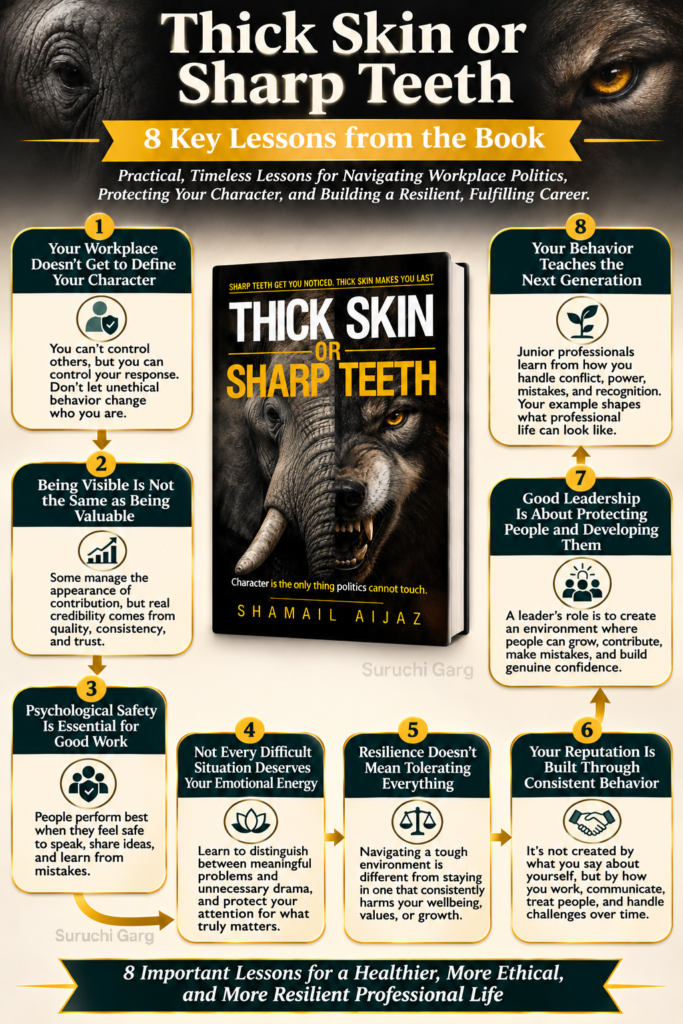
8 Important Lessons from Thick Skin or Sharp Teeth
Beyond workplace politics and difficult personalities, the book offers several valuable lessons about professional growth and personal development.
1. Your workplace doesn’t get to define your character
You may not control the behaviour of your colleagues, managers, or organisation. However, you can decide how you respond to those behaviours.
Don’t let someone else’s lack of integrity become an excuse to compromise your own.
2. Being visible is not the same as being valuable
Some professionals become skilled at managing the appearance of their contribution. However, genuine professional credibility comes from the quality of your work, consistency, and the trust you build over time.
Recognition matters, but it shouldn’t become the only measure of your worth.
3. Psychological safety is essential for good work
People cannot consistently perform at their best when they are afraid of making mistakes, expressing concerns, or sharing new ideas.
A healthy workplace makes honesty safer than carefulness.
4. Not every difficult situation deserves your emotional energy
Learning to distinguish between meaningful problems and unnecessary workplace drama helps you preserve your attention for things that genuinely matter.
Sometimes, the most effective response is not to react immediately.
5. Resilience doesn’t mean tolerating everything
There is a difference between navigating an imperfect environment and remaining in an environment that consistently compromises your wellbeing, values, or ability to contribute.
Leaving can sometimes be an act of professional integrity.
6. Your reputation is built through consistent behaviour
Your professional reputation isn’t created by what you say about yourself. It develops through the accumulated evidence of how you work, communicate, treat people, and handle difficult situations.
7. Good leadership is about protecting people and developing them
A leader’s responsibility isn’t simply to extract performance. It is to create an environment where people can grow, contribute, make mistakes, and develop genuine confidence.
8. Your behaviour teaches the next generation
Junior professionals observe how experienced people handle conflict, power, mistakes, and recognition. The way you conduct yourself today becomes an example of what professional life can look like tomorrow.
What Makes Thick Skin or Sharp Teeth Stand Out?
What makes Thick Skin or Sharp Teeth interesting is that it doesn’t treat workplace politics as a problem that can be solved simply by becoming more politically skilled.
It recognises that organisational environments are complicated and that difficult personalities, competing interests, and unfair situations are part of professional life. However, it challenges the assumption that surviving these environments requires becoming equally manipulative.
Another strength is its balanced approach to individual and organisational responsibility. The first parts focus on the professional’s internal development, while the later chapters examine how leaders and organisations can change the conditions that encourage harmful behaviour.
The chapter on leaving without becoming bitter is particularly meaningful. It acknowledges that sometimes professionals don’t leave because they failed; they leave because the environment has become incompatible with the person they want to be.
The T.H.I.C.K. framework also gives readers a practical structure they can revisit when navigating difficult professional experiences.
Who Should Read Thick Skin or Sharp Teeth?
This book can be particularly valuable for:
Working professionals who are navigating office politics, difficult colleagues, or unhealthy workplace dynamics.
Young professionals and fresh graduates who want to understand workplace culture before developing unhealthy professional habits.
Managers and team leaders who want to build trust, encourage honest communication, and support their teams.
HR professionals and executives interested in improving organisational culture and psychological safety.
High-performing employees who feel overlooked, undervalued, or affected by colleagues who compete through politics rather than contribution.
People considering a career transition who want to recognise unhealthy workplace patterns and make more informed decisions about their next environment.
If you believe that professional success should not come at the cost of personal integrity, this book offers a perspective worth exploring.
Final Thoughts:
The most meaningful idea I took away from Thick Skin or Sharp Teeth is that difficult environments don’t have to turn us into difficult people.
We can become more aware without becoming suspicious of everyone. We can establish boundaries without becoming hostile. We can be ambitious without taking advantage of others, and we can protect ourselves without losing our ability to trust.
Not every workplace will reward honesty. Not every colleague will recognise genuine contribution. And not every organisation will provide the environment in which we can do our best work.
But we still have a choice about the professional we are becoming.
The book leaves readers with a powerful reminder:
“Every workplace contains sharp teeth but Not every professional needs to grow them.”
Perhaps that is what a meaningful professional life is really about: achieving success without losing the qualities that made that success worth pursuing in the first place.
Frequently Asked Questions (FAQ)
What is Thick Skin or Sharp Teeth about?
Thick Skin or Sharp Teeth explores workplace politics, toxic professional behaviour, leadership, organisational culture, and professional resilience. It explains how individuals can navigate difficult workplace environments without compromising their values.
What is the T.H.I.C.K. framework?
The T.H.I.C.K. framework consists of five principles: Truth Recognition, Healthy Boundaries, Internal Stability, Character Consistency, and Keep Moving. Together, they provide a practical approach to professional resilience and ethical career development.
Is Thick Skin or Sharp Teeth useful for managers and leaders?
Yes. Its leadership chapters explain how managers can encourage psychological safety, distribute credit fairly, protect employees from harmful behaviour, develop talent, and build healthier workplace cultures.
Who should read Thick Skin or Sharp Teeth?
It is suitable for working professionals, young graduates, managers, HR professionals, team leaders, and anyone interested in personal development, workplace relationships, leadership, and professional integrity.
What are the ten workplace archetypes discussed in the book?
The book explores the Talent Hunter, Shadow Saboteur, Gatekeeper, Chameleon, Credit Collector, Complaint Merchant, Political Operator, Fear Manager, Invisible Fence, and Morale Miner.
You might also like
- All Posts
- Book Recommendations
- Non-Fiction Books
- Author Interviews
Recent Posts

Suruchi Garg
Suruchi is a reader and book influencer passionate about helping readers find books that truly impact their lives. She was listed as Top book influencer among top 60 Indian book influencers in 2025. With the experience of over 4 years and was trusted by more than 300 authors she aims to make reading a transformative experience.
Latest Blog
Featured


Sign Up for The Newsletter for Updates on Writing, Tour, and More

Book influencer and self help enthusiast.
Book influencer and self help enthusiast.
Contact Info
readsbookly@gmail.com
@booklyreads
Navigation
- Home
- About
- Book
- Contact